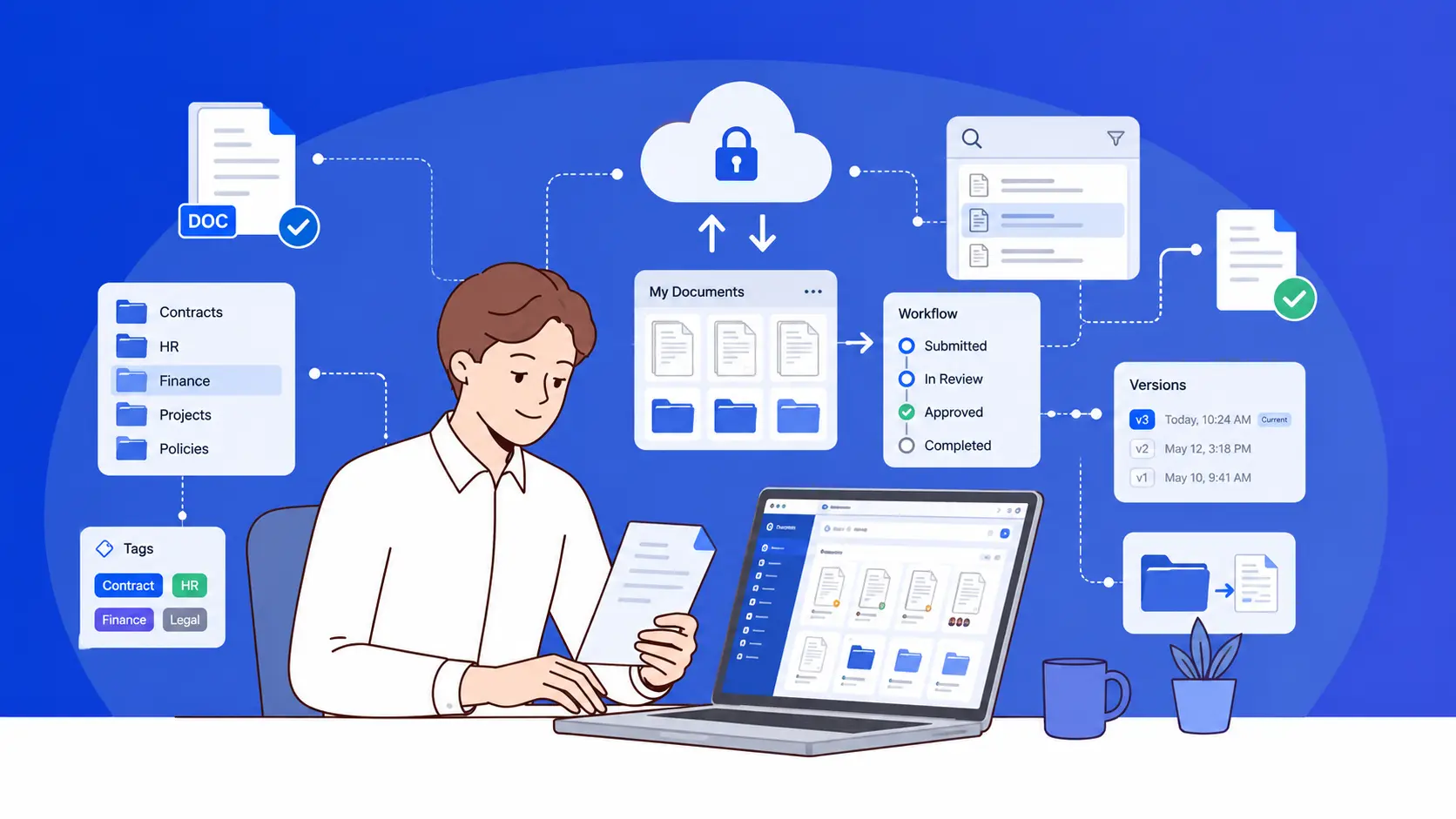
Content lifecycle management is the structured approach organisations use to control documents and information from creation through to review, approval, publication, archiving and eventual disposal. In simple terms, the content lifecycle management definition is this: it’s the governance framework that ensures the right content is created, approved by the right people, accessible to the right users, reviewed at the right time, and retired when no longer valid.
For organisations operating in regulated or high-risk environments (think construction, finance, childcare, real estate etc.), that structure is not optional. It is fundamental to compliance, accountability and operational integrity.
Every organisation produces content — policies, procedures, contracts, technical drawings, quality manuals, safety documentation, HR records. The problem is rarely creation. The problem is control. Without a defined content lifecycle management process, documents can:
In certain sectors, unmanaged content is more than an inconvenience… it’s a total governance risk. Effective content lifecycle management introduces discipline. It establishes ownership. It provides traceability. And most importantly, it ensures the organisation can demonstrate control — not just assume it.
While implementations vary, most structured environments follow a consistent set of content lifecycle management stages.
The difference between basic document storage and structured content lifecycle management lies in governance. True lifecycle control provides:
This is where content lifecycle management software becomes essential. Manual systems cannot reliably scale governance across departments, sites or jurisdictions. For organisations leveraging Microsoft 365 and SharePoint, the challenge is not platform availability — it’s structured enforcement. SharePoint provides flexibility. Lifecycle management provides control.
One of the most common misconceptions is that content control ends at publication. In reality, unmanaged review cycles create one of the largest compliance gaps within organisations. Policies that were correct three years ago may now be misaligned with regulatory changes. Procedures that once reflected operational best practice may no longer be accurate. Without automated lifecycle triggers and compliance oversight, organisations operate on assumptions — not certainty.
Content lifecycle management addresses this by embedding accountability into the system itself.
Modern content lifecycle management software does more than store documents. It enforces structure. Key capabilities typically include:
When integrated properly within Microsoft environments, lifecycle controls can operate seamlessly without disrupting user familiarity. The result is governance without friction.
Many organisations believe they have lifecycle management because they have document libraries. But storage is not lifecycle management. A true content lifecycle management definition includes governance logic — not just file locations. It requires:
Without those elements, document control becomes reactive rather than strategic.
At KeyDocs, we see content lifecycle management not as a feature, but as a governance framework built into the way organisations operate. By extending Microsoft 365 and SharePoint with structured controls, automated workflows and compliance oversight, KeyDocs enables organisations to implement a fully auditable content lifecycle management process without abandoning the tools they already use.
Our platform is designed to:
Rather than building complex custom solutions, organisations can adopt structured lifecycle control with clarity and confidence.
When implemented correctly, content lifecycle management reduces risk, strengthens compliance posture and improves operational consistency. It ensures that documentation reflects reality. It demonstrates governance to auditors and regulators. It provides leadership with visibility. Most importantly, it protects organisational integrity.
Content is not static. It evolves… and so must the systems that manage it. Structured lifecycle management ensures that evolution is controlled, traceable and compliant at every stage.
Check out our other posts!